Saturday, February 7, 2009

Obligatory Gay Cher Post

ARTS_Cher.jpg
...I just don't understand how anyone would want to be a Republican. I just can't figure it. I don't understand. If you're poor, if you're any kind of minority -- gay, black, Latino, anything. If you're not a rich -- I don't know. If you're not a rich born-again Christian, I don't get it." -- Cher,
who should consider going on a national tour to movie-smack every Republican across the face and tell them to "Snap out of it!" Thanks to Melissa McEwan at AlterNet

Friday, February 6, 2009

A Different Angle

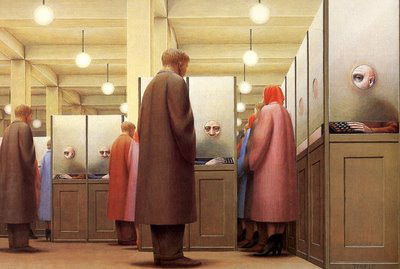
tooker government bureau2 1956.jpg

George Tooker

1 Republic: Founding (Constitution)
2 Republic: Civil War
1st Empire (After Reconstruction)


3 Republic: Rise & Fall of Labor (Roosevelt-Truman)
4 Republic: National Security State (NSC, CIA, Cold War)
2nd Empire (George H.W. Bush...
)


This is not an original thought. In fact I've swiped the idea from IOZ, quoted below. I've merely elaborated and named the Republics. It gives one (or me, at least) a whole new perspective on the broad outline of American evolution. I'm not saying it couldn't be modified or reworked a half dozen different ways. But that the French are really onto something, thinking of their governmental history in terms of separate republics. It lifts one out of the realm of parties, of quadrennial changes in management, and focuses, instead, on the current structure of power and it's goals.

The French conveniently subdivide their post-Revolutionary history into numbered Republics. Makes reference easier and all. America might do the same, with our First Republic lasting from the promulgation of the Constitution and Bill of Rights to the Civil War, the Second lasting through the brief era of Reconstruction, the Third lasting through the period of expansion and Empire through the First World War, the Fourth beginning under Roosevelt and lasting through the early years of the Truman Administration, the Fifth beginning at the creation of the National Security Council, the Central Intelligence Agency, and the apparati of the Cold War, and the Sixth and current starting with the fall of the USSR, the Gulf War, and the stewardship of George H.W. Bush. IOZ Numerology

The question remains: whether this is the Dawn of the Republic V or a continuation of  Empire II. So far, the signs are not terribly hopeful. To quote from Margaret Kimberley, writing in Dissident Voice:

The usually peaceful people of Iceland threw out their government after international banksters destroyed their economy. The French, never shy about protesting, took to the streets to show their government that they wouldn’t be silent as unemployment rises and wages fall. The rest of the world may make demands on their political leadership, but Americans are stuck in a morass of apathy and ignorance brought about by corporate media disinformation....
Citizens ought to demand drastic cuts in military spending for the nation that spends more on defense than the rest of the world combined. Instead they are foolishly impressed when Obama puts on a show and pretends to be concerned about corporate jets and billion dollar bonuses on Wall Street...
Easily fooled Americans were glued to the television watching the Obama inauguration while simultaneous(ly) ignoring their own worsening financial situation. Who can bother to look at the fine print on multi-billion dollar deals when HISTORY is being made? Now the same zombified population ignores presidential inaction on bankruptcy “cramdown” legislation that could save their homes, explicit threats to Social Security, and backtracking on employee free choice for labor unions.
In their delusion and despair, the only reaction left to non-class conscious Americans is to turn on themselves. Murders and suicides are too often the reaction to financial disaster instead of righteous indignation directed towards a failed political and economic system. Americans are losing their minds when they might alleviate their depression by taking to the streets or at the very least giving their elected leaders a piece of their minds.
Americans never had the tools to fully understand the system that is failing them so terribly. Now they are enthralled by a man who explicitly instructs them not to confront the people and institutions that have brought them to the brink.

What's most interesting in the Republic Model is the patterns that emerge. First an increase in the military, for whatever reasons: Civil War, the Cold War, followed by a flourishing of imperialistic aspirations. Or, to put it another way, the population is pummeled into submission by fear and propaganda, so that the autocrats can grab the reins of power. What's less evident is how that power, once grabbed, is ever returned to the Demos. In this, America is not an exemplar. It occurs to me, also, that in the spaces after the empires, one might have inserted the marker, "...Financial Ruin..." and added yet another level of interpretation.

Wednesday, February 4, 2009

Go Little, My Tragedy.

If you would like to read the poem I read at my mother's wake/memorial service, go here.

Oh, my god...

They've Santa Fe Styled my Ancestral Home!

SD_273.png

Photo courtesy of Jane Phillips and Shell MacKenzie.
Also thanks to Ray Peters and Ed Crocker for the information.

Monday, February 2, 2009

A Poem


At night Chinamen jump
on Asia with a thump


while in our willful way
we in secret, play


affectionate games and bruise
our knees like China's shoes.


The birds push apples through
grass the moon turns blue,


these apples roll beneath
our buttocks like a heath


full of Chinese thrushes
flushed from China's bushes.


As we love at night
birds sing out of sight,


Chinese rhythms beat
through us in our heat,


the apples and the birds
move us like soft words,


we couple in the grace
of that mysterious race.


Frank O'Hara

A wicked tongue...

Bibliomania.png


I was so taken by yesterday's idea of columns-within-the-blog that I decided to construct one for my other great passion: books. Alas I haven't written anything on the subject recently; and I'm still deeply involved in City Poet: The Life and Times of Frank O'Hara, by Brad Gooch. (see in Sidebar, and click for the FO'H site) It's a big, thick tome: 470 pages, not including Notes and Index. It is, for me, a "read-before-going-to-sleep" book; the kind one takes in small enjoyable morsels, over time, letting it become part of one's daytime state-of-mind by inducing doses just before sleep. Eventually, I'll formulate an opinion of it and him. But right now I'm just enjoying the process.

Biographies of poets are, in my mind, both fascinating and frustrating. But I can't seem to get enough of them. An example is the last big one I read: Hart Crane: A Life, by Clive Fisher, which left me in an absolute fury. What a selfish, rich, self-pitying little shit! I've learned, over the years not to do bad reviews unless there's simply nothing else to say. Or, even better, say nothing. Perhaps the writer himself wasn't sympathetic, and someone who really liked Crane would tell the story in much different terms. But this was a book I hurried to finish and, through the last half, kept considering giving up altogether, except that I was curious about his death. I concluded, however that he was definitely a man I would not have wanted to know (no matter how sexually acrobatic he may have been), which sounds priggish, I know. Maybe I was just dramatizing to cover my own inability to find any merit in his pretentious poetry, when so many people admire it.

Whatever the final judgement, I'd better give you the full particulars, dear reader, so you can make up your own mind (although I wouldn't recommend it), and I've included a bit of review, filched from Google.

books.jpeg

Hart Crane: A Life; By Clive Fisher; Edition: illustrated; Published by Yale University Press, 2002; ISBN 0300090617, 9780300090611; 567 pages

A gifted writer with a weakness for alcohol, a demanding mother and an untimely death by suicide, American lyric poet Hart Crane (1899-1932) might easily be mistaken for Ernest Hemingway, who was born the same day a few hundred miles away. Crane’s tragedies and creative struggles, like Hemingway’s, make for compelling biographical fodder. Clive Fisher, a very close reader, explicates attentively, and his meticulous detective work also sheds light on Crane’s forays into the gay underworld and the tense family dynamics that dominated much of his life. The book is less successful at sustaining a historical and intellectual trajectory, and, like his subject, Fisher likes to indulge in the occasional ecstatic ramble. Cahners Business Information (c) 2002


Sunday, February 1, 2009

Michael MOApp

Toolbox logo.png

If you look at the lower part of the sidebar, you'll see that I've added a component called "Toolbox." Look inside, you'll find the 35 applications I use most frequently... at present. I've spent so much time and money searching for the Mac utilities that suit my needs, I thought it might be interesting, and maybe even helpful, for me to write a fairly regular column, discussing what I've discovered and giving reasons for my choices.

Thus I decided to start with one of my favorites, which is representative of an entire new line of small simple applications, designed by the multi-talented Michael Göbel, called myOwnApps (I know, I know, but read on, there's a wonderful off-center logic to it.) The sample I've chosen is called myWords, an application for writers. This is a highly competitive field for Mac development right now. Some of the biggest guns in the shareware world are offering very evolved, sophisticated tools for novelists and playwrights, each with an avid following.

myWords icon.png

So, why did I chose this funny, slightly old-fashioned, oddly eccentric myWords? Well, partly because of all those supposed "drawbacks;" I'm not intimidated by it. It's totally flexible and fits my changeable work habits. Or to put it more negatively, it doesn't force me to work within a pre-concieved "writer's model." I make up the rules and categories, and change them at will. "Works," Entries," "Snippets," "People," and "Places" are the only inbuilt hierarchy. And there's that big yellow notepad at the top to remind me to keep notes as I go. Instead of learning software, I write. It's all up front.

But more to the point of why one makes these choices: this is Mac programming as it was originally meant to be. As far as I know MOApp is Michael, and cats. No corporate structure, pretend or otherwise. I've been following his output since the first (really eccentric) "Suite". He charges very little, but has always made it perfectly clear that they are a work-in-progress. They've progressed amazingly over the last several years. And, all along, I've felt personally involved. His sense of style is impeccable; it guides not just his design of interface, but an underlying philosophy of "simple is better."

myWords.png

I'm torn between wanting him to do really well, and keeping him my own secret source of satisfying tools. One recognizes a craftsman by his attention to details. myWords is typical of all MOApp designs, there is a joy in small details: a hidden picture viewer, the Snippet drawer that can become a palate, the way the window zooms to letterbox, or slides off the left corner of the screen on closing. There is also a means to take a snapshot of any current state in case a rewrite goes awry; and there are several ways to print/export. Occasionally there is a slight weirdness in function or odd transliteration from German. But these just make me smile, there's nothing to struggle with, and Michael's answer to inquiries is very fast, if a little terse.

I will probably be writing more about MOApp in upcoming columns. There is a much more sophisticated line of products at his site. These myApps are a response to requests from people, like me, who haven't yet upgraded to Leopard. But they're the same quality, just not quite as slick. At this point, there is no reason why these excellent applications aren't more widely known and discussed, except for their German or strange English names and lack of current "kitchen sink" mentality of adding more bells and whistles in lieu of making smooth, solid tools that do one thing simply and flexibly.

Michael's company is die Gestalteriche.